Helleno-Uralic theory refers primarily to my original etymological research of the Hellenic and Uralic language families, specifically regarding proposed ancient Greek loans into some of the Uralic proto-languages.
BACKGROUND
The premise of Helleno-Uralic contact is that ancient Greek and Uralic speakers would have lived in the same zone near the confluence of the Volga and Kama rivers (present-day Tatarstan, Russia). The Greeks in question would have most likely been the Gelonians/Geloni/Gelōnoí/Γελωνοί, described in Book 4 of Herodotus’ Histories (available on Wikisource in English and the original Greek). The Gelonians are reported to have originated from the northern Black Sea during the Archaic period of Greek history, when colonists and traders from the Aegean began forming various settlements on the coast (e.g. Olbia, Taganrog) from the 8th or 7th century BCE onward. Based on Herodotus’ description of the Gelonian’s whereabouts (east of the Tanais/Don river into the Sarmatian steppe, then 15 days north into the forest zone by a large body of water), I have approximated their primary city of Gelonus/Gelōnós/Γελωνός to somewhere on the right bank of the Volga – perhaps anywhere from the Volga-Sura confluence to the Volga-Kama confluence. Unfortunately, Herodotus reported that the wooden city of Gelonus was burned to the ground by the Persians, due to the Gelonian’s military support of the Scythians. Gelonus was located in the large and populous nation of the Budini/Boudînoi/Βουδῖνοι; and the agricultural Geloni and nomadic Budini shared the city. Northeast of the Budini nation, other groups were also described: The Thyssagetae (for which no description is provided); the Iyrcae/Iúrkai/Ιύρκαι, who hunted in the forest with the help of a horse and a dog; and finally the Argippaeans/Argippaîoi/Αργιππαῖοι, who were peaceful and bald men and women living under “Pontic” trees (prob. the bird-cherry: Prunus padus), at the foothills of mountains.
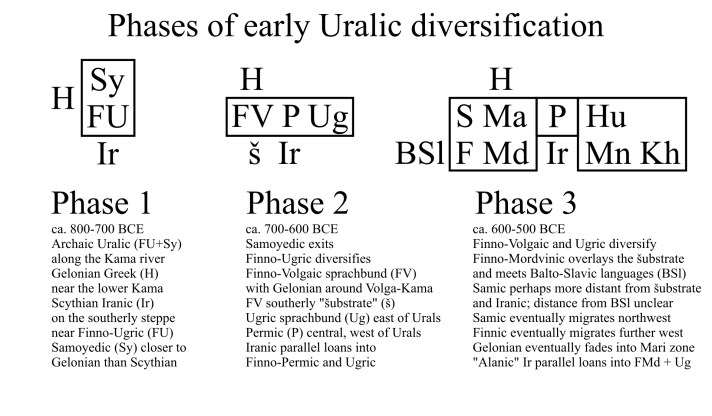
The Uralic speakers in question lack a definitive historiographical background, but I have consulted the interdisciplinary evidence to likewise approximate their location to the Volga-Kama confluence during the Classical period of the Ananyino culture. As part of Helleno-Uralic theory, I propose that Proto-Uralic speakers would have migrated from the Lozva-Atlym culture on the Lower Ob to the Kama river, just before their linguistic diversification from ca. 800-500 BCE. I will not elaborate further on this proposal here, but more on this diversification model may be found in the draft “The synchronization of Iranic and Hellenic loanwords in Proto-Uralic (Response to Holopainen 2019)”. I will make an in-depth post about Proto-Uralic archaeology and archaeogenetics in the future.
The following figure provides a brief overview of my working Helleno-Uralic diversification model:
ETYMOLOGY
The primary evidence in support of Helleno-Uralic theory is its paradigmatic etymological research. The Hellenic loanword basis includes Finno-Ugric and even Samoyedic reflexes, with a semantic focus on riparian travel and contact (see e.g. “The oldest Greek loanwords in Proto-Uralic“). Other natural and cultural aspects of contact can also be lexically reconstructed, such as a secondary phase of loans into the Finno-Volgaic languages (see e.g. “Greek in the western Uralic sprachbund“). A full list of the current working lexicon, with linked sources, may be found here.
NOTE 1: Each category is alphabetized, and divided into two segments: The first segment is wider reflexes, and the second is lemmas limited to terminal branches.
NOTE 2: The non-initial reduced vocalism may appear here as *-e, *-i, or *-ə. The mainstream view is that only one of these values should be used. If I had to choose only one, it would be *-ə – however, I am open to the possibility that *-i and even verbal *-e could be additionally possible in certain environments (honestly, I just like that this makes the comparanda look better superficially for my auxlang: I’ll probably change them all to *-ə at some point).
++++
Riparian features and travel terms:
áros ‘flood meadow’ > FU *ara
áza ‘dry land (along a stream)’ > FU *aća
diáge- ‘to cross, pass’ > FU *jakka-
elá- ‘to go, visit’ > U *elä-
kuklé- ‘to travel (downstream), wander about’ > U *kulke- (DISPUTED)
mḗlǣ ‘probe > paddle’ > FP *melä
muskhǽ ‘bay, bend, corner, creek: riverbend’ > U *mučka
ókhtha ‘riverbank > land route between water routes’ > U *uktə
orgás ‘fertile meadow in a forested river-valley’ > FU *orka; Ma орга́ж
póros ‘bridge, ferry, river passage’ > FU *pora
skáphǣ ‘dugout canoe’ > FU *kappə ~ Ug *kʌppə
vênos ‘boat’ > WU *wenəš
—-
nâma ‘foreland’ > F *nämə >> niemi
(e)pholkǣ́ ‘small towed vessel’ > F *pulkka (UNCERTAIN)
Plants and animals:
dôma ‘house > bird-cherry tree’ > U *d’ʌmə
khórtos ‘fodder, grass’ > FV *korttəš >> F korte
maîa ‘midwife > beaver’ > FP *maja
móron ‘blackberry > cloudberry’ > U *mura (UNCERTAIN)
ourǣ́ ‘tail > squirrel’ > U *ora
phoítǣ ‘mad roamer > ermine’ > U *pojta
phúskǣ ‘animal guts’ > U *pučkV
psúros ‘?weever > pike’ > FU *ćurə
sargíon ‘type of schooling fish > roach’ > FU *särki
thaimós ‘seedling’ > FV *taiməš
thallós ‘herbage’ > FV *tälləš
—-
kíssa ‘type of bird with blue wings’ > Ma киса́
kókkos ‘conifer cone, conifer nut, strobilus’ > F *kukka
lókhos ‘horse (that lies in wait for ambush)’ > Ug *lox (UNCERTAIN)
phúlla ‘type of leafy green > turnip’ > Ma пула́
phullís ‘type of leafy green > cow parsley’ > Ma пуле́ж
vátos ‘blackberry, raspberry’ > F *vat(t)a (vattu)
Other natural terms:
áŋkos ‘lowland’ > FV *äŋkəš ~ Ma э́ҥгыш
krymós ‘cold, frost’ > FP *külmä ~ *külməš (DISPUTED, UNCERTAIN)
psŷksis ‘cooling weather > autumn’ > FU *ćükći
thúella ‘stormwind’ > FP *tuwələ (DISPUTED [initial vocalism])
—-
ákrǣ ‘hill’ > Ma арка́ (UNCERTAIN)
nomǣ́ ‘pasture > moor’ > F nummi
págos ‘frost’ > F+S *pakka ~ *päkkəš
raktós ‘ravine’ > F rotko (UNCERTAIN)
Sociocultural terms and activities:
diakhé- ‘to butcher, cut up (meat), divide, separate’ > U *jaka- ~ *jʌka-
katékhe- ‘to cover’ > U *kätkə-
keiríǣ ‘swathe > bark, bast’ > FU *keri (UNCERTAIN)
kormós ‘piece of tree trunk > tree bark’ > FV *kolməš (UNCERTAIN)
kraté- ‘to endure, hold’ > FV *kärte-
(é)ksodos ‘military expedition > war’ > U *ćoδ́a
ksúlon ‘wooden ladle’ > U *ćulə
ksunkle- ‘to close, shut’ > FMd *ćulkə- (UNCERTAIN)
langé- ‘to push away’ > FU *loŋe-
logé- ‘to calculate, count (on one’s fingers)’ > U *luke-
moûsa ‘incantation; spirit’, ‘to incant, invoke’ > FU *moša ~ *mušV
nuré- ‘to push’ > FP *nure-
phusá- ‘to blow’ > U *pušə-
psalé- ‘to cut’ > U *ćälä-
sákkos ‘sieve’ > U *sokta-
tsŷkon ‘swelling, wart’ > FV *ćükə-lä ~ *ćVklä
válle- ‘to pour’ > FMd *wala-
zôma ‘scale armor; animal skin;? money’ > FU *ćʌmə
—-
áge- ‘to ravage, rob’ > Ma ага́ш
aikǣ́ ‘time’ > F+S *aika
aísthǣ ‘sense’ > F *aista
áze- ‘to be angry’ > Ma ажа́ш
érga ’embroidery’ > Ma ерга́
íze- ‘to sit’ > FMd *ise-
iugǣ́ ‘noise, sound (of a voice)’ > Ma *juk > йӱк
kikkós ‘cheat, dice trick’ > F kikka
kourís ‘blade’ ~ koûris ‘spear’ > Ma куре́ж ‘fish-spear’ (UNCERTAIN)
kytís ‘cupboard’ > Ma кыде́ж
líthos ‘stone; building-stone’ > F *litə-na ~ *litna ‘castle, city, fortress, town’
onǣ́ ‘good luck’ > F onni
mûthos ‘conversation, speech, word’ > Ma мут (DISPUTED)
ósse- ‘to see’ > Ma ужа́ш
oukí ‘no’ > Ma уке́
(u)páge- ‘to flee, go away, withdraw’ > F *pake- (DISPUTED)
pugǣ́ ‘back, rear (of a blade)’ > Ug *pukkə (DISPUTED)
ripíze- ‘to pour, scatter, throw’ > F ripise-
rothíze- ‘to crack, creak, crunch’ > F rutise-
roumíze- ‘to be rough, tremble’ > F romise-
ryphá– ‘to slurp’ > F ryyppä-
siōpǣ́ ~ sōpǣ́ ‘calm, silence’ (<? *syup-) > Ma шып (UNCERTAIN)
suríze- ‘to buzz, hiss, pipe, whistle’ > F surise-
syrkáze- ‘to smile’ > Ma шыргыжа́ш (*šürgö)
(e)toímǣ ~ (e)toîmon ‘activity’ > F toimi
tómos ‘piece (of cloth, covering)’ > Ma ту́мыш
varkáze- ‘to cry, shout’ > Ma варгыжа́ш
—-
Related threads:
“Helleno-Uralic theory” (The original forum-version of this post, on GenArchivist.net)
“Unique features of the Proto-Uralic lexicon“
“Genetic composition of Proto-Uralic speakers” (Post #618)
(NOTE: Helleno-Uralic theory has not yet been formally published or peer-reviewed, although that is the eventual plan: I am just waiting on 1. An updated Uralic etymological dictionary, and 2. Archaeogenetic samples from the Lozva-Atlym and Gamayun cultures, in order to provide a more decisive conclusion about how Hellenic and Uralic would have interacted.)
 Finngreek