
Before we review the latest of the Finngreek language, I’d like to give an update on the status of Helleno-Uralic research. I am still revising “Helleno-Uralic Contact in the 1st Millennium BCE” for its eventual publication. This has been a much longer process than I had anticipated, but I am admittedly a slow worker. In addition, I will prioritize more of my time to making videos on social media, which I will post more about here upon their release. I hope you all will enjoy this new content! However, it also means that the finalization of my paper will continue to be a slow process. I appreciate the patience you all have had in waiting for its completion.
With that being said, let’s learn some new Finngreek!
++++

kaúsima ‘fir, spruce < firewood’
U *kuse ‘fir, spruce’ (UEW) ~ *kowsi ~ **kVwsV <
H καύσιμος ‘combustible (of wood)’ (LSJ) < καίω ‘to burn, kindle’ (FEE) <? IE *keh₂u-
The Uralic lemma here can not be clearly reconstructed (Aikio 2012: 243), with proposals including *kuse ~ *kose (UEW), *koγsi (Zhivlov 2014: 139), and *kowsi (Aikio 2022: 23). This environ is phonologically similar to FU *owδ’is̆ < aûthis and FMd. *kowma < kaûma; but the ambiguity of U *kVwsV leaves room for vocalic interpretation of the H source term. This etymon will need to be revisited in future research, since the initial U vocalic reflexes of *owδ’is̆ and *kVwsV do not parallel each other (and *kowma is not informative beyond Finno-Mordvinic).
There is no HU paradigm for a trisyllabic etymon at the Proto-Uralic chronological depth, which may explain a syllable-final elision. It is perhaps worth consideration that loaning occurred from a related dialectal form of e.g. H καῦσις ‘burning’ ~ καῦσος ‘lands fertilized by burning brushwood’ (LSJ), but this is not semantically parsimonious. Also, while HU kaúsima is etymologically related to HFMd. kaûma, it is unclear whether these terms had a cultural relationship during HU contact, or if they were used in mutually exclusive contexts.
In any case, this etymon aligns semantically with other proposed HU dendronymic developments, where popular material terminology resulted in the name for a type of tree, as in HU dôma ‘bird cherry < house’, HFP tomǣ́ ‘oak < timber’, and HP+Ug. skáphǣ ‘poplar < canoe; trough’. HU kaúsima ‘fir, spruce < firewood’ therefore implies that fir and spruce trees were designated for use as firewood in Gelonian Greek. H καύσιμος has been used to describe combustible wood in ancient Greek; and its derived noun καύσιμο refers to ‘fuel’ in modern Greek, as a semantic loan from French carburant.
khórtos ‘horsetail < green fodder’
F korte ‘horsetail’ < *kort’ëh < FV *korttəš
< H χόρτος ‘green fodder’
Probably cognate with Mari kə́rtəš / кы́ртыш ‘type of grass’. Horsetail, especially water horsetail / Järvikorte, was historically used as fodder for horses, cattle, and pigs in Finland. The plant is also a popular food for deer. However, it is unclear which animal(s) would have been provided such fodder during HU contact, or if the original plant was in fact horsetail.

langé- ‘to push away, release, slacken’
FU *loŋe- (> Finnish luo, Hungarian lóg) (UEW) <
H λαγγεῖ (λαγγάζω [FEE], λάγκει) < ?
The semantic value ‘to release’ here is not explicitly attested, but is reconstructed per Ma. ‘winnowing’, Ud. ‘to throw out’, F + Ms. ‘to give birth (too early)’, and H ‘= ἐνδίδωμι (LSJ): to disembogue, empty itself (of a river)’. There may also be a contextualization of this etymon to the tension of cables, as seen in intra-Hellenic and intra-Uralic derivations such as H λογγάσια ‘stones with holes in them, through which mooring cables were passed’ (LSJ, GML) < λογγάζω ‘; and FMd. loŋe-ma ‘warp thread’ (UEW).
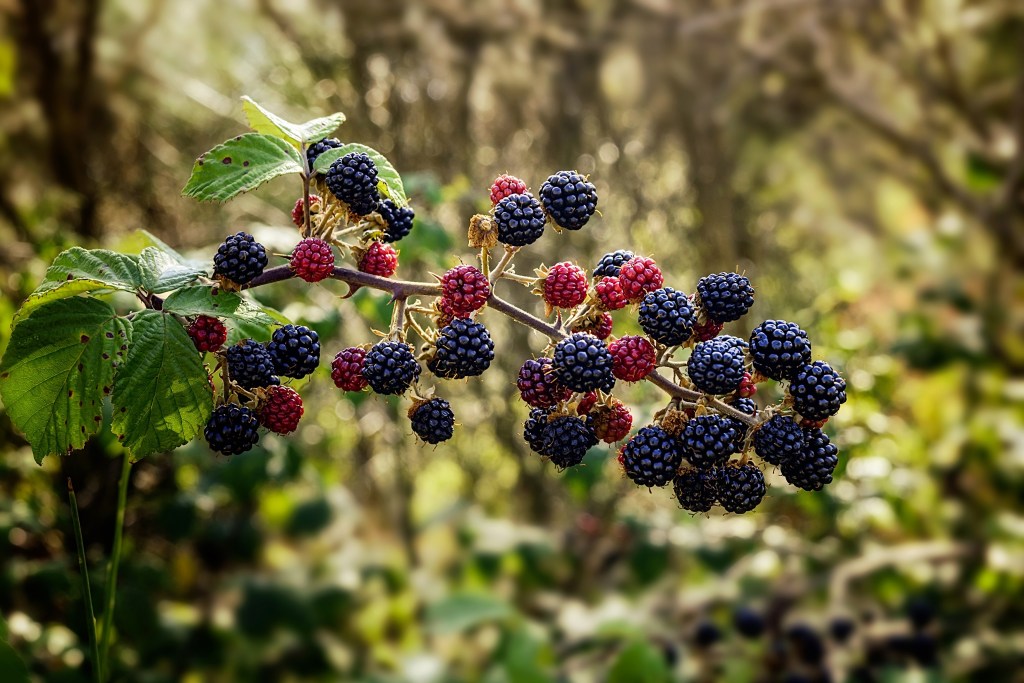
vátos ~ váton ‘blackberry, bramble, raspberry’
F vattu ~ vatukka ‘bramble, raspberry’ (SES) <
H βάτος ‘blackberry, bramble, raspberry’ (LSJ, FEE) ~ βάτον < ?
The F forms were previously considered to have been derived from F vata ‘chickweed’ (SES), but the latter may have been a loan from a source akin to Swedish våtarv ‘chickweed’; and I argue that there is not a similarity between the chickweed and bramble to assume an etymological derivation: Among other typological disparities, chickweed does not bear a similar or even significant fruit, which is the primary use of brambles such as blackberry and raspberry.
F vattu is described as a back-formation from vatukka, but it is also possible that vatukka was a typical formation from vattu, or even a hypothetical **vatta/o/e/i. It is also worth consideration that a lost noun *vata ‘bramble’ could have been semantically replaced by ‘chickweed’, due to existing derivations such as vatukka, which filled in the semantic gap. Similar terms such as F vaapukka, vaarain, and vadelma ‘raspberry’ (SES) all present unclear or irregular phonological environs, and so must be excluded from this proposal until they can be independently etymologized.
++++

krymothumós ‘feeling of cold’
Finnish kylmäntunne (kylmä + tunne), !Greek κρυμοθυμός (κρυμός + θυμός)
Only a real compound term in Finnish, but understandable enough in Greek. See Helleno-Finno-Permic krymós + Helleno-Uralic thumós.

onenomé ‘field of fortune’
!Finnish onnennummi (onni + nummi), !Greek ονενομή (ονή + νομή)
Not an original Helleno-Uralic compound; but a nice view all the same. See HF onǣ́ + nomǣ́.
 Finngreek