Happy New Year!
For the past 5 years, I have been on the Finngreek journey – gaining an education in Uralic historical linguistics and anthropology, developing Helleno-Uralic theory, and drafting what will eventually be my debut paper on the topic.
My original plan was to publish this paper as soon as possible, but the scale at which I wish to present this theory will require more time and effort – not only on my part, but also on the part of other authors in the field to continue their research. The 2020s have been revolutionary in Uralic historical studies: After decades of authors proposing their original views (and others building on those views), the past 5 years have been a boon in critical responses, which have reshaped the field to its current state of taxonomical agnosticism and problematic diachrony. Traditional and alternative taxonomical views (e.g. Finno-Ugric, Finno-Samic, West Uralic, East Uralic, Ugric) have been rejected in favor of the nondescript Comb model, i.e. 9 unique branches without any definitive exclusive relations to each other (I do, however, support an exclusive Finno-Mordvinic affinity, which has not yet been formally discredited). Meanwhile, we continue to wait for an updated Uralic etymological dictionary: The last one by Karoly Redei is now 40 years old, and often obsolete. The publication of a new etymological dictionary, such as the one in progress by Ante Aikio, will allow for me to continue my work in alignment with a current, comprehensive, and mainstream view of the Proto-Uralic lexicon.
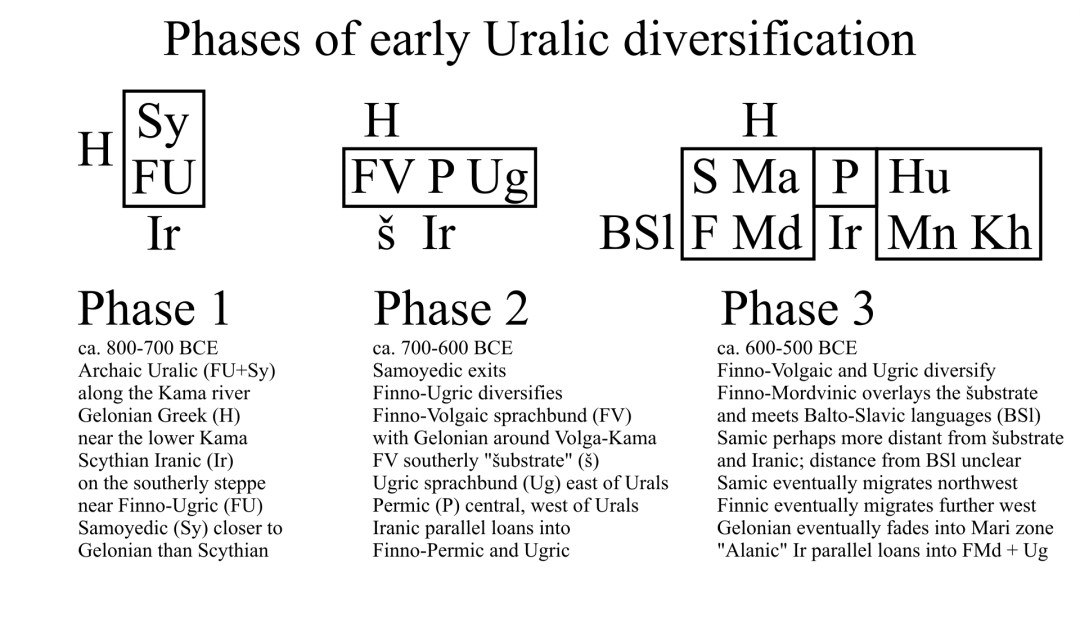
The potential archaeogenetic factor of Proto-Uralic expansion, in comparison with my cultural model of Uralic diversification from the Lozva-Atlym culture into the Ananyino horizon via Gamayun-Itkul migrations, is also in critical need of more data. The suggestion of the arrival of Proto-Uralic speakers to the Urals from Yakutia (see Zeng et al. 2025, Grunthal et al. 2022) does not elaborate on any intermediate phases of Proto-Uralic from its alleged expansion through the Seima-Turbino Phenomenon into its terminal branches; and there are also zero samples from the Lozva-Atlym or Gamayun cultures to support or refute their presumed demographic influence on the Ananyino culture. With only one sample from the Itkul culture available thus far, a huge question mark is left looming over the Urals region in regards to when, where, and how the Uralic proto-language(s) diversified. Since the most current mainstream views on the linguistic and archaeogenetic factors of Proto-Uralic are inconclusive, I have to wait for these matters to be resolved (or at least improved) before I can then present my own conclusions. While I continue to reason that Atlym > Ananyino is the most attractive option for Archaic Uralic expansion from the upper Kama, and thereby for Helleno-Uralic contact on the lower Kama ca. 800-500 BCE, I still need a complex of relevant archaeogenetic samples and diachronic taxonomy in order to support my findings. Until then, anything I propose beyond the Helleno-Uralic etymologies can only be viewed as speculative.
For now, I think it would be a good idea to let the current state of Helleno-Uralic research marinate for a few years while awaiting further advancements in Uralic historical studies. In the meantime, any updates to Finngreek will no longer be discussed in quarterly summaries, but as impromptu posts whenever a topic is important enough to merit discussion. I will also be focusing on unrelated projects during this time, since I already prioritized the past 5 years to work on Finngreek. Hopefully in the next 5 years, there will be enough progress by Uralic researchers to allow me to make those necessary conclusions about Helleno-Uralic theory.
It is nice to take a break when the journey lasts a lifetime. Éla muskhǽn…
++++
Check out:
“The oldest Greek loanwords in Proto-Uralic“
“The synchronization of Iranic and Hellenic loanwords in Proto-Uralic“
 Finngreek